There is a lot of noise about AI diagnosing disease, and most of it is either breathless hype or reflexive dismissal. Neither helps a hospital administrator or clinician trying to decide what is actually worth adopting. So let me be practical about what AI medical diagnosis software does well, where it fails, and how to think about it in an Indian setting.
What "AI Diagnosis" Really Means
The phrase covers several very different things:
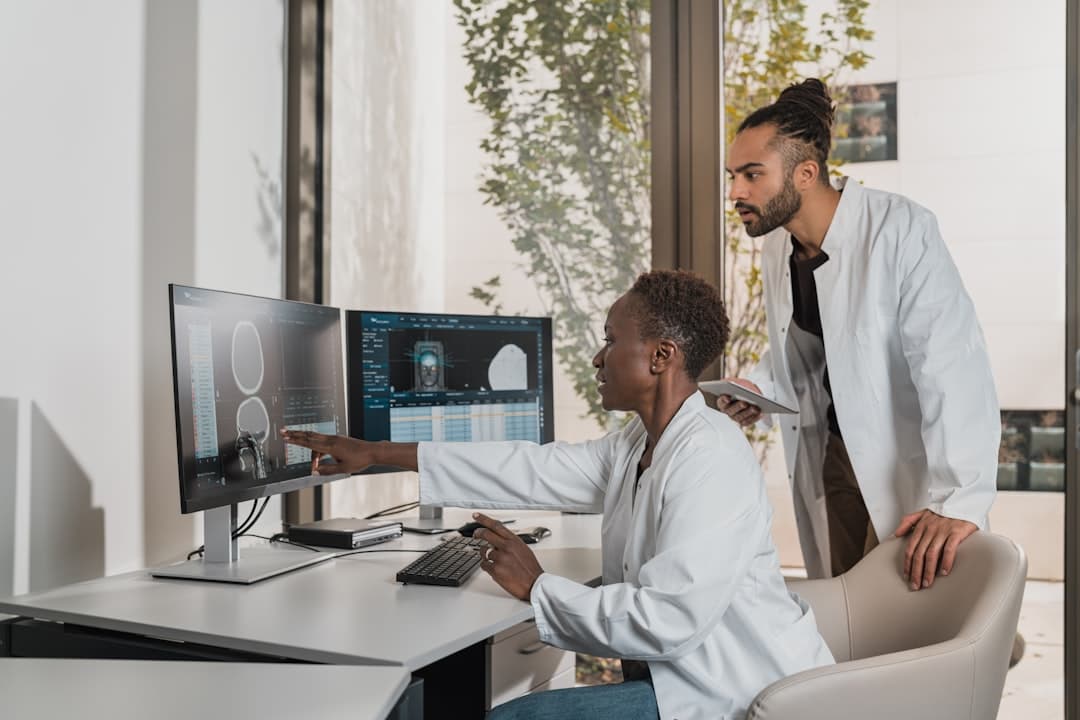
- Image analysis — AI reading X-rays, CT scans, retinal photos, or pathology slides to flag likely abnormalities
- Risk scoring — models estimating the probability of a condition from labs, vitals, and history
- Symptom-based suggestion — tools that take symptoms and produce a ranked list of possibilities
- Decision support — surfacing relevant guidelines or catching contradictions in the clinical picture
These are not equally mature. AI image analysis for specific findings is genuinely strong. General "tell me what's wrong from symptoms" tools are far weaker and should be treated with caution.
Where It Genuinely Helps
Screening at scale. In a country with too few radiologists and ophthalmologists for its population, AI that flags abnormal chest X-rays or diabetic retinopathy in screening programmes is a real force multiplier. It does not replace the specialist; it triages so the specialist's time goes to the cases that need it.
Catching the easy-to-miss. A tireless model reviewing every scan can flag the subtle finding a fatigued human eye skips at the end of a long shift. Used as a second reader, it improves safety.
Prioritisation. AI can push the likely-urgent scan to the top of the queue so a critical finding is seen in minutes, not hours.
Consistency. A model applies the same standard at 9 AM and 9 PM. Human performance varies with fatigue; the AI does not.
Where It Fails — And Why That Matters
It is brittle outside its training. A model trained on one population, one machine, or one image quality can perform badly on another. An algorithm validated in the US may not hold up on Indian patients or older equipment. Validation on relevant data is not optional.
It does not understand context. The AI sees the scan, not the patient. It does not know the history, the exam, or the thing the patient said that changes everything. Diagnosis is more than pattern-matching, and AI only does the pattern-matching part.
It can be confidently wrong. A model will output a probability even for a case unlike anything it has seen. Without a clinician's judgement, false confidence is dangerous.
Bias in, bias out. If the training data under-represented a group, the model will be less reliable for that group. In a diverse country, that is a real risk.
The Right Mental Model
The useful way to think about diagnostic AI is not "a doctor in a box." It is a second pair of eyes that never gets tired, applied to a narrow task it has been proven good at, whose output a qualified clinician always interprets.
Under that model, the doctor stays in charge. The AI flags, prioritises, and double-checks. The clinician interprets and decides. Responsibility never moves to the algorithm.
How This Fits an Indian Hospital or Lab
Most Indian providers will not build diagnostic AI; they will adopt it, and the practical question is integration. A diagnostic flag is only useful if it reaches the right person inside their normal workflow — attached to the study in the hospital system, or to the report in the diagnostic lab software — rather than sitting in a separate portal nobody checks.
Before adopting any diagnostic AI, ask:
- What exactly is it validated to do, and on whose data?
- What is its performance on patients like ours?
- How does its output reach our clinicians in workflow?
- Who is accountable when it is wrong — and is that clear to everyone?
- Is it regulated appropriately for clinical use?
If those answers are vague, the tool is not ready for your patients.
The Bottom Line
AI medical diagnosis software in 2026 is a powerful assistant for specific, validated tasks — especially image screening in a country short on specialists. It is not a replacement for clinical judgement, and any vendor implying otherwise should worry you.
Adopt it for what it is: a way to see more, faster, and miss less — with a doctor always making the call. To see how diagnostic outputs and reports flow into a unified patient record, explore the GoMeds hospital management system and diagnostic lab software, or request a demo.
Frequently Asked Questions
Related software
Ready to transform your healthcare business?
See how GoMeds AI can automate your operations, reduce costs, and improve patient outcomes with a personalized demo.
Tags
Written by Dr. Ashwin Reddy
Published on 20 May 2026